1966 Dime: the Coinage Act of 1965 Impact
The 1966 dime is living proof of the consequences of the law on the revaluation of precious metals in foreign currency, and if the same coin had great value a year earlier, then exactly one year later everything changed.
Of course, both in the past and now, all this affects the market, and experienced numismatists who are savvy in the subject of precious metals are trying to buy back more expensive and valuable copies that were not released before 1965.
But this does not mean that tokens coming out later are not needed or interesting to anyone — for each coin there will be a collector.
The Legal Context: The Coinage Act of 1965
The Coinage Act of 1965 changed coin production because:
- The market price of silver was increasing
- Old silver coins were too costly for the government to produce
- The country had a money shortage
The new law had several main effects on the dime:
- It removed silver completely from dimes and quarters
- It reduced silver in half dollars from ninety percent to forty percent
- It stopped the use of mint marks for five years (1965–1967)
- The goal was to stop people from collecting the coins and solve the circulation problem
Physical and Technical Features of the 1966 Dime
The 1966 dime is made of clad metal. It has three distinct layers:
- Outer Layers: 75% copper and 25% nickel
- Inner Core: 100% pure copper
The clad structure has been standard since 1965:
- Total Weight: 2.268 g
- Diameter: 17.91 mm
- Thickness: 1.35 mm
- Edge: Possesses 118 reeds
Design and Lettering
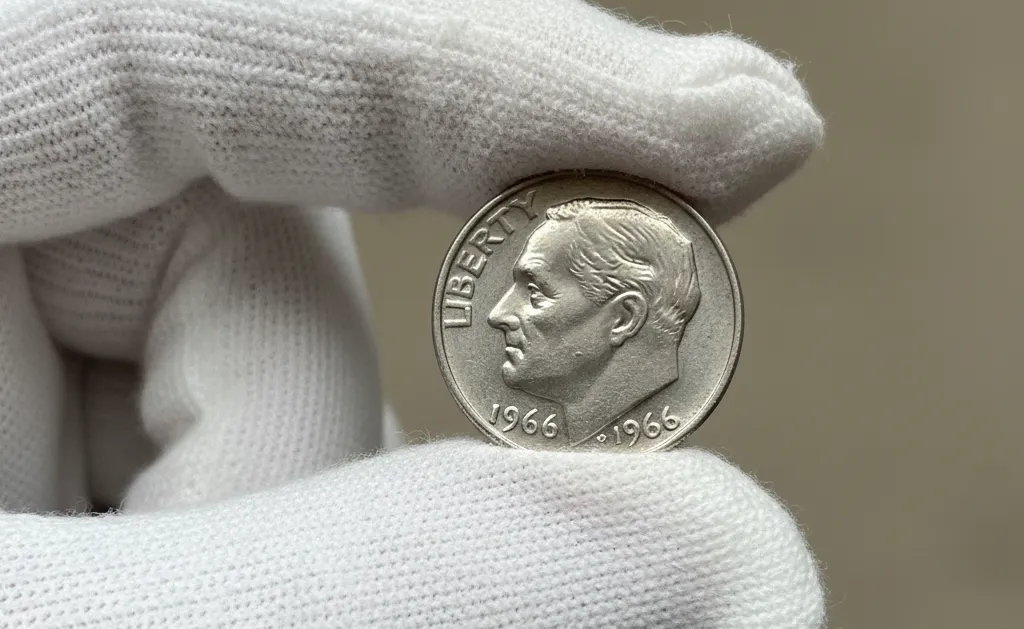
The front side shows the profile of President Franklin D. Roosevelt, looking to the left, and including the words “LIBERTY” on the top, “IN GOD WE TRUST” on the left side, the date “1966” on the bottom right, and the small letters “JS” for the designer’s name under the president’s shoulder.
This coin not showing any mint mark because of the 1965 law, meaning all three mints made the exact same coin, and the back side showing a torch in the center, placed between an olive branch, and an oak branch, meaning strength, with the words “UNITED STATES OF AMERICA” at the top, “E PLURIBUS UNUM” between the branches, and the value “ONE DIME” at the bottom.
Production Volume, Mintage, and Distribution
The production of the dime in 1966 took place at three different United States Mint locations: Philadelphia, Denver, and San Francisco, having circulation of 1,382,734,540 pieces.
As for Special Mint Sets, these SMS sets replaced the standard Proof sets between 1965 and 1967, and were made in San Francisco using more pressure during striking, giving the coins clearer and stronger details compared to the regular coins.
Condition Grading and Known Errors
Most 1966 dimes kept in very high, clean condition are called uncirculated.
Some known errors make coins more valuable:
- Missing Clad Layer: The coin is lighter and shows the red color of the pure copper core. Sometimes only one outer layer is present.
- Rotation Error: The front and back pictures are not lined up straight.
- Metal Die Error: Faults caused by a broken metal die during the production process.
Comparison of Physical Features: 1964 Dime and 1966 Dime
Looking closely at the silver dime from 1964 and the clad dime from 1966 shows important technical changes, the metal composition moving from ninety percent silver to the copper and nickel clad structure.
| Feature | 1964 Dime (Silver) | 1966 Dime (Clad) | Difference |
| Composition | 90% silver, 10% copper | 75% copper, 25% nickel | Silver completely removed |
| Weight | 2.50 grams | 2.268 grams | Lower by 0.232 grams |
| Diameter | 17.91 mm | 17.91 mm | No change |
| Mint Mark | Present (D or P) | Absent | Legislative temporary restriction applied |
Technological Process for Clad Coin Production
Making the clad 1966 dime required new production ways. The main steps were:
- Joining Layers: The pure copper core and the two copper-nickel outer sheets were joined using high heat and strong pressure.
- Thinning: The plate was made thinner many times until it reached the needed 1.35 mm thickness.
- Cutting Blanks: Round blank coins were cut out from the thin plate.
- Raising the Rim: The blanks went through a process to raise the rim around the edge.
- Striking: A ring with 118 lines held the coin, the top and bottom metal dies hit the blank at the same time, putting the design and edge lines onto the finished dime.
Effect of the Mint Mark Ban on Production Reports
The temporary stopping of the mint mark use seriously changed how the Mint reported its work in 1966, the total mintage number of 1,382,734,540 pieces being given as one final figure, making it impossible to find the exact number of coins made at the Philadelphia, Denver, and San Francisco mints.
Since the coins looked exactly the same, and the law stopping the marks being created to try and lower the amount of collecting activity — the government believed was causing the coin shortage, this rule later being stopped, with the marks returning in 1968, but placed on the front side, marking the years 1965 to 1967 as a unique time when the place of production was not shown on the dime.
How to Store the 1966 Dimes
You should store the coins in a safe and dry place, avoiding touching the coins with your bare hands because the oil from your skin can damage the metal over time, and instead using soft cotton gloves for holding them, utilizing special plastic holders or folders.
These containers keep the coins from touching air and dirt, and never use regular plastic bags because some bags have chemicals that can hurt the coin’s surface, keeping the coins in a place where the temperature doesn’t change much, such as a safe box or a drawer.
Where to Sell the 1966 Dimes
You can sell your 1966 dimes in many places, the price depending on the coin’s condition, meaning the price will be higher if the coin is graded high.
Common places for selling coins include local coin shops, where you can ask the shop owner to look at your coin and offer a price, online markets, allowing you to list your coin for sale, requiring clear pictures for online selling.
As for the coin shows, there are large meetings where many people buy and sell coins, where an expert can also help you know the coin’s value, or you can send the coin to a grading company, this will say exactly how good your coin is, helping you get a fair price.